
There is hardly a single metric by which Slovenia has not regressed under Robert Golob’s government. From the absorption of cohesion funds, economic growth and industrial production to exports — Slovenia has gone from a success story to Europe’s problem patient. The days of Janez Janša, when we were at the top, are now only a memory. The latest OECD data confirm this: real wages are rising in the organisation’s member countries, while Slovenia is once again below average.
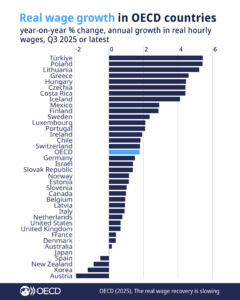
The new report, released yesterday, indicates that real wages continue to grow in practically all OECD countries. However, the pace of recovery is slowing, and in half the countries wages still remain below their early 2021 levels — just before the post-pandemic inflation surge. Slovenia is once again significantly below the average.
Wage growth in OECD countries in recent years has been between 1 and 2 percent compared to 2021 (the last full coronavirus year). In many countries wages have still not reached pre-inflation levels. In Slovenia this growth is between 0 and 1 percent. Slovenia thus ranks among the countries that have not yet recovered the losses from the coronavirus period.
But note: this figure also includes all the artificial (i.e. politically driven) wage increases that the government has introduced outside economic reality and which have severely damaged the economy — from the minimum wage and Christmas bonuses to the big explosion: the new public administration pay reform. Despite these artificial measures, they have failed to improve the outcome, which points to two key factors:
Inflation in Slovenia has been persistently higher than in OECD countries. At the same time, the private sector — which did not benefit from the government’s public-sector “sweeteners” — is considerably poorer than under the previous government (despite the pandemic). Average wages in the private sector are now several hundred euros lower than in the public sector.
A two-tier state of the privileged is emerging, yet we still cannot match average OECD wage growth. This means that private-sector workers have slipped at least two social classes lower than before Golob’s government came to power.
Inflation is eating up the artificial wage increases
Last year we reported on OECD data covering September and October 2025, tracking year-on-year inflation measured by the consumer price index (CPI). Alongside Turkey, Slovenia stood out negatively with explosive food price growth. Inflation in this segment — the most sensitive for middle and lower classes — reached an astonishing 6.8 percent. Recall that inflation is often called the “tax on the poor”, because it affects them the most. Their family budgets are usually already exhausted by the end of the month, unlike wealthier households with financial buffers. This is especially true for basic foodstuffs.
When compared with food inflation in neighbouring Italy, which stood at 2.5 percent, it becomes clear why shops in Slovenia’s coastal region are practically empty. Many consumers are shopping in nearby Muggia, Opicina, Gorizia and Trieste — and paying significantly lower Italian taxes instead. The problem is that Slovenia stands out against the global trend of generally easing inflation. This suggests the issue is not driven by international factors such as post-coronavirus money printing or the war in Ukraine.
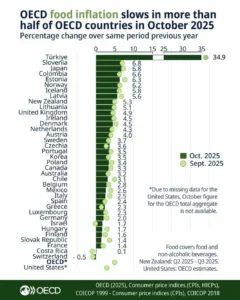
Inflation was stable or generally stable in 14 out of 37 OECD countries for which data are available. Overall inflation decreased in 13 countries and increased in the remaining 10.
What went wrong?
Let us recall that in 2021, the respected magazine The Economist ranked Slovenia in second place among OECD countries for its success in handling the coronavirus crisis. Then came a dramatic reversal. Four years of Golob’s far-left government have left marks on Slovenia that will take generations to erase. Into an already egalitarian society, the coalition introduced an even stronger socialist equalising policy. Thus Slovenia — a country that proudly boasts of its egalitarianism — has become a trap of poverty from which escape is almost impossible.
For the exact opposite reason that diametrically opposite policies in Argentina have produced diametrically opposite results. Argentina opened up to foreign investment, deregulated, reduced bureaucracy, drastically cut taxes and limited public spending. The results have been impressive — the country tamed hyperinflation in record time, the economy is growing again, public debt is falling, and real poverty is declining.
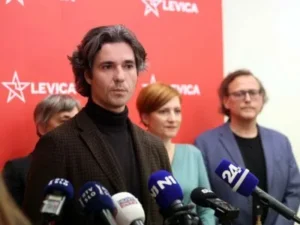
In contrast, Golob’s government has isolated the market from foreign investment, raised taxes (especially on wages), and made an already uncompetitive tax environment even less attractive. Bureaucracy increases daily, and new regulatory legislation is constantly being adopted that interprets already strict EU directives even more restrictively. Under the influence of the far-left Levica party, the coalition has been at war with the economy, employers and private initiative for three years. In such an environment, nothing flourishes. We live in a country that wishes to be self-sufficient in its isolated reality, where corruption and nepotism thrive, while operating in a global world that requires cooperation and openness.
The Slovenian economy is fighting with admirable effort against the government’s harmful policies, but ultimately the scars of egalitarianism remain visible. Just as with the green transition, which the government is also forcing through at the expense of the economy, the negative effects are felt first by the most vulnerable and the poorest. A Slovenian minimum-wage worker no longer belongs in the EU — they have fallen deep into the Balkans. The reported wage growth is, in reality, little more than accounting fiction.
Mitja Iršič
