
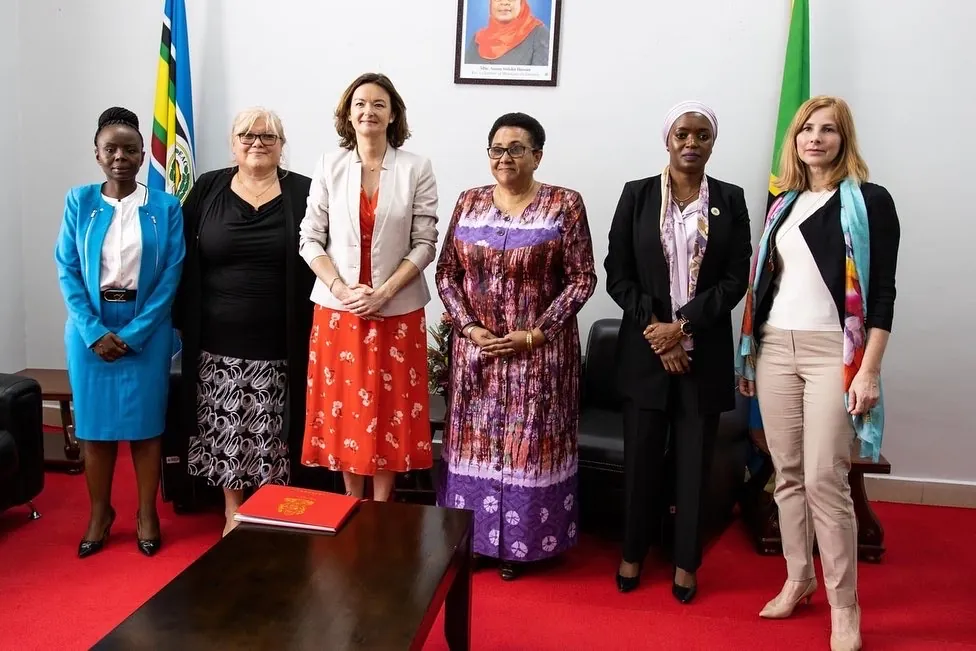
Not long ago, Slovenian Foreign Minister Tanja Fajon visited Tanzania, a country led by President Samia Suluhu Hassan – a leader who has become a global talking point in recent months due to an increasingly obvious pattern of nepotism in government appointments.
According to international reports, the top echelons of Tanzanian politics are filled with her close relatives and family friends. It is therefore hardly surprising that such a regime felt familiar and comfortable to the Slovenian foreign minister, given that Slovenian politics also loves to hire and reward “its own people” – something we have repeatedly seen in numerous personnel changes and appointments based far more on loyalty and affiliation than on professional merit.
When Minister Fajon enthusiastically meets a leader who staffs her government with relatives and personal acquaintances, the parallels in political practice are impossible to ignore. President Samia Suluhu Hassan has assembled her cabinet as follows:
- Minister of Finance – her brother-in-law
- Minister of Health – her son-in-law
- Deputy Minister of Education – her daughter
- Member of Parliament – another daughter
- Minister of Defence – a long-time family friend and wedding mediator
- Deputy Minister of Labour – her niece
This appointment system has sparked heated debate about whether Tanzania is being run as a modern democracy or as a regime that looks orderly on the outside but is built on personal ties on the inside.
Fajon wants to deepen cooperation
During the visit, Tanja Fajon emphasised the exceptional economic opportunities, describing Tanzania as Africa’s fastest-growing economy and an attractive market for Slovenian companies in energy, digital technology, water management, green economy, and food security. She also expressed a desire to strengthen political dialogue and bilateral cooperation, presenting the country as a strategic partner and opportunity for Slovenia. Precisely because of such statements, the visit takes on a completely different dimension. When the leadership of the country we are visiting is clearly permeated with nepotism, such enthusiasm for cooperation sends a signal that Slovenian politics has no particular qualms about moving closer to regimes where the highest positions are privileges reserved for family connections and personal loyalty. This is not just an internal Tanzanian problem – it is also a question of political ethics for any country deciding with whom and in what manner it wishes to associate. When a minister enthusiastically poses for photos and speaks of a country’s progress while that same country is simultaneously placing relatives in strategic posts, it is hard not to see that she is framing her own foreign-policy credibility in the exact same terms: rewarding one’s own, giving preference to closed circles, and completely ignoring the difference between democratic values and a reality of power that disregards them.
Is Tanzania really an attractive market for Slovenian companies?
One additional fact completely dismantles the minister’s claim that Tanzania is an interesting market for Slovenian firms in the above-mentioned sectors: trade between the two countries is barely detectable. For years, the total volume of trade has hovered around just a few million euros – representing less than 0.005 % of Slovenia’s overall exports.Slovenia mainly exports pharmaceuticals, medical supplies and some technical equipment to Tanzania – a very limited, highly specialised segment driven by global supply chains, not by political visits. Imports from Tanzania amount to roughly half a million euros per year and consist primarily of agricultural products and textiles – economically negligible.The EU has just cut €156 million in aid to TanzaniaThe whole situation becomes even more telling in light of the fact that, just days ago, the European Union cancelled €156 million in development aid to Tanzania for 2026.The reason: lack of confidence in the transparency, oversight and management of public funds. In other words, the EU has clearly stated that Tanzania’s current political structure is not an acceptable platform for spending European money.
A. G.
