
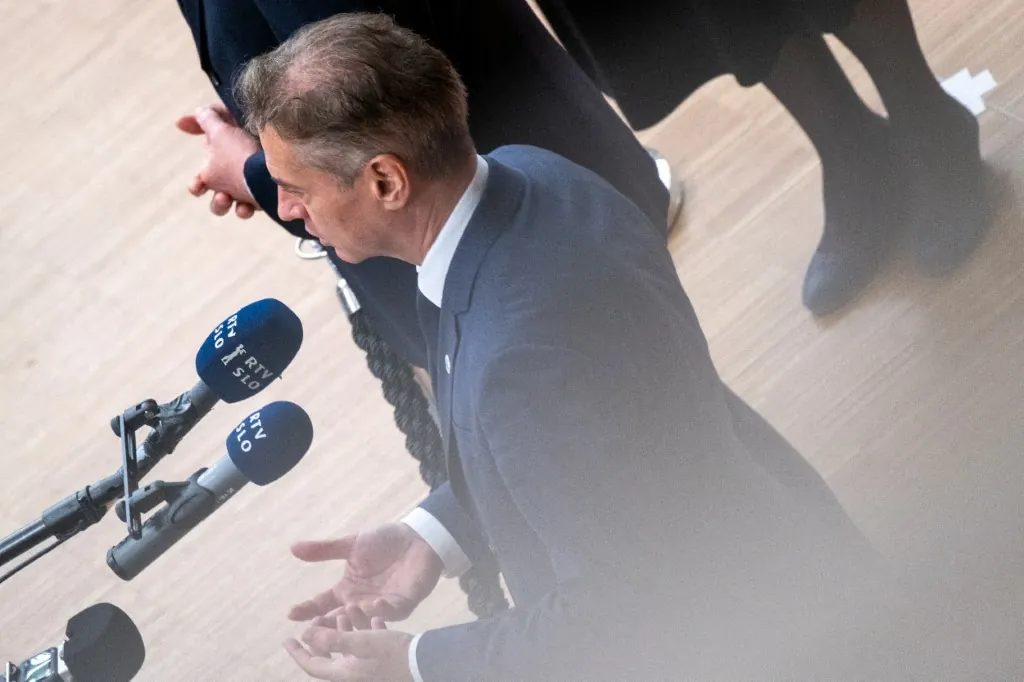
Freedom of expression in Slovenia has regressed under the government of Robert Golob. Until now, this was clear to everyone in the country — both to those who were restricting freedom of expression and celebrating it as “depoliticization,” and to their victims. Now it has also become clear to the international community.
According to the Freedom of Expression Index, Slovenia has fallen to an unenviable 81st place out of 179 countries. Even more telling: “The report introduces a watch list of countries showing early signs of improvement or deterioration in democracy that should be closely monitored in the near future. Among the seven countries showing signs of deterioration are Slovakia, Slovenia, and Cyprus.”
The disastrous results in the area of freedom of expression were expected. At Nova24TV, we have been warning from the very beginning of this government’s term about the dangerous moves of Robert Golob’s administration, which chose “depoliticization” of public media and public administration in general as one of its key goals. It began with purges at RTV Slovenia when the Constitutional Court enabled the implementation of key provisions of the new RTV Act. The amendment wiped out the existing governing bodies, illegally terminated their mandates, and the new leadership professionally degraded or showed the door to everyone who was not in line with the new authorities or with the activist group of pro-government journalists. Recently we witnessed another episode of direct political pressure on the creators of the show Tarča (“Target”), who were apparently — at least that’s how it looked from the outside — threatened with losing their jobs because of their work. This case is especially telling because the very same Tarča team, during the previous government, played a key role in the persecution of the former Minister of Economy Zdravko Počivalšek in the “ventilator” affair, for which the prosecution later fully acquitted him. One might say that the revolution at RTV has begun to devour its own children.
On the other hand, journalists who were not aligned with the activist group of the so-called “nobody’s servants” faced attacks from government-friendly civil society. We need only recall the brutal verbal assault launched by poet and left-wing activist Svetlana Makarovič against Dr. Jože Možina with her shameful text.
Persecution of opposition mediaAt the beginning of its term, the government also launched a pogrom against opposition media, especially the one you are currently reading. A special parliamentary investigative commission was established whose primary purpose was to settle scores with “SDS” — in other words, to exert political pressure on critical opposition media. In the end, even the former chair of the investigative commission, MP Mojca Šetinc Pašek, admitted as much.At the same time, the government dramatically increased funding for media loyal to it, which most benefited the so-called “media tycoons,” who are now repaying the favor with servile reporting.
We have of course seen similar attempts to influence editorial policies in the past, even before the current government. Let us only recall the call by former Prime Minister (now MEP) Marjan Šarec that state-owned companies should not advertise on Nova24TV.
Tomšič: There has undoubtedly been a regression
We asked Dr. Matevž Tomšič, president of the Association of Journalists and Publicists, for a comment. He explains that there has been a regression both in freedom of expression and in media openness and pluralism. “We know how those who speak negatively — either about those in power or about the activists, the so-called NGOs connected to the ruling coalition — have been sanctioned. We have the case of Roman Vodeb, who was punished because he ‘spoke ugly’ about the Speaker of the Parliament Urška Klakočar Zupančič; then there is the case of Vinko Vasle, who was punished because he expressed himself ‘inappropriately’ about Nika Kovač.”
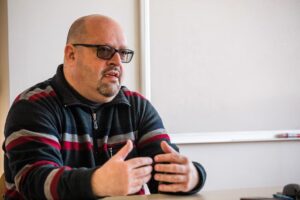
Tomšič also reminds us of what has been happening at the national broadcaster, where the so-called “depoliticization” has led to a complete political monopoly that has now reached even the Tarča program. “In short, there has undoubtedly been a regression in this area,” he concludes.
Castrated NGOs
The question also arises: why do we in Slovenia have to wait for studies by foreign non-governmental organizations (in the case of the Freedom of Expression Index, prepared by the V-Dem Institute at the University of Gothenburg in Sweden)? Why do Slovenian NGOs working in the field of human rights or media not detect these negative trends? “The NGOs in our country that deal with media are mostly connected to left-wing politics. As such, they have difficulty critically evaluating what is happening in terms of the current government’s attitude toward media freedom,” he explains.
How to reverse the negative trend?
Tomšič explains that if we want to reverse the negative trend of the extinction of freedom of expression in Slovenia, we would need to abolish those parts of the legislation that allow ex officio prosecution for insulting politicians or other “important people.” “If someone who feels offended believes their honor and good name have been violated, they should assert that themselves through civil lawsuits,” he suggests. In his opinion, we would also need to achieve a truly pluralistic media space in which only those media close to the left political option are not privileged. A space must be created where all media, regardless of their worldview, have equal opportunities to operate. We should abandon practices that, on the one hand, try to reward certain media with public funds while, on the other, attempting to sanction or pressure media that are on the “black list,” he adds.
Ž. K.
