
“Golobism” has wormed its way into every pore of Slovenian society. Besides the economy, the hardest-hit area is the right to expression – not just freedom of speech, but all forms of expression: online opinions, statements by opposition politicians, and what the media write or report.
Until now, we could only speak anecdotally about a “street-level feeling” that anyone who wasn’t aligned with Golob’s coalition felt less safe than before. Now we have hard numbers.According to the Freedom of Expression Index, Slovenia has plummeted to 81st place out of 179 countries!The top 15 consists almost exclusively of developed Western democracies (plus two former communist countries that have made exceptional progress):
- Denmark
- Iceland
- Switzerland
- Belgium
- Estonia
- Czechia
- France
- Luxembourg
- New Zealand
- Finland
- Sweden
- Norway
- Canada
- Australia
- Germany
The bottom of the 179-country list is occupied by communist dictatorships, Arab despotisms and countries of the so-called “Russian world” (North Korea, Nicaragua, Russia, Belarus, China, UAE, Qatar, Saudi Arabia, Cuba, Turkmenistan, Afghanistan, Azerbaijan…). To the horror of many, Slovenia is now exactly midway between these regimes and the advanced Western democracies.Slovenia thus finds itself in 81st place – by far the worst EU country (except for Hungary, which is even lower) and the worst country in the broader European space (except for Hungary and Serbia).
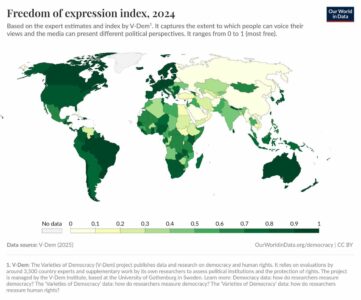
The suppression of free speech has now received real, numerically backed international resonance.Slovenia’s scores have been falling steadily:
- 2020: 0.868
- 2023 (first year of the Golob government): 0.824
- 2024: 0.731
This year, the V-Dem project specifically highlighted Slovenia on its watch list: “The report introduces a watch list of countries showing early signs of improvement or deterioration in democracy that should be closely monitored in the near future. Among the seven countries exhibiting signs of deterioration are Slovakia, Slovenia, and Cyprus.”
Suppressing free speech in the name of “freedom
It has never been a secret that the current government wants to “discipline” the media and reward only the obedient ones.
Prime Minister Robert Golob himself openly admitted to RTV journalist Tanja Starič that he and RTV journalists had pledged to “cleanse” the police and the public broadcaster of “Janšists” (not Janšism as an ideology, but people who simply disagree with him politically). Even parts of the left were shocked at the time – the statement sounded like something out of a Latin American socialist autocrat.Since then, Golob’s coalition has “liberated” (i.e. “depoliticised”) public broadcaster RTV Slovenija, stuffed it with their own activists, and illegally dismissed every journalist who was ideologically incompatible. Remember: before the “depoliticisation,” Golob himself refused to give interviews to RTV Slovenija. They also passed a media law that rewarded “their” media tycoons and introduced state censorship – not only for traditional media but even for influencers. Meanwhile, their politicians sue private media outlets for daring to parody them (e.g. Tamara Vonta is suing our outlet while simultaneously persecuting it politically through the parliament’s “investigative commission” that hunts opposition “witches”). Journalist and editor Jože Biščak and Aleksander Škorc were convicted (with prison sentences) for satire, yet Minister Luka Mesec was acquitted after calling Bernard Brščič a fascist.
On media funding calls, money goes exclusively to left-wing mouthpieces; since the beginning of this mandate, not a single right-wing medium has received any funding. Even the director of the Peace Institute had to admit that on the right there is no medium reaching more than 100,000 readers or listeners – naturally, because of repression and widespread political-corporate censorship. As Valentin Areh said at a press conference of the Association for the Values of Slovenian Independence, their portal is currently the strongest right-wing medium in the country, with around 80,000 readers.Nevertheless, censorship – at least for now – is working, although corrective mechanisms, thanks in part to the internet, are slowly but surely emerging.
Kajzer: A drop this large doesn’t happen without causes
Former Slovenian ambassador to Washington, Tone Kajzer, wrote on X:
“Could someone please verify whether the UN data are correct? It’s simply hard to believe that we Slovenians have fallen to 81st place in freedom of expression. If this is true, I expect immediate action. The media that are not part of the monolith have been ‘ringing the alarm bells’ for some time.”In a statement to Nova24TV he added: “It’s hard to imagine such a massive drop in such a short period without causes. I’m not an expert on ‘freedom of expression,’ but judging by the input data used to calculate this and similar indices, one could conclude that the ‘space’ the state provides – for example through funding of the public broadcaster – for pluralistic and free interpretation of events at home and abroad has shrunk. In this regard, the situation with public RTV and the media law (whose constitutionality we still don’t know because of the Constitutional Court’s silence) presents itself as a possible explanation.”
What is the Freedom of Expression Index?
The annual Freedom of Expression Index is part of the V-Dem (Varieties of Democracy) project run by the V-Dem Institute at the University of Gothenburg, Sweden. The project collects global data on democracy and human rights. Assessments are made by approximately 3,500 country experts who, together with V-Dem researchers, analyse political institutions and the protection of rights.The index comprises more than 500 indicators and 245 sub-indices covering various aspects of democracy, including freedom of expression. It is a legitimate, widely recognised index based on systematic methodology, peer-reviewed, and frequently used in academic research, international reports and comparative analyses. Results are published in openly accessible datasets and visualisations that enable comparisons across countries and over time.More broadly, V-Dem is an international research project that systematically measures and compares levels of democracy and human-rights protection worldwide, emphasising that democracy is not a one-dimensional concept but comes in many different forms and characteristics.
M. I.
